

On Saturday 25 July, clergy and parish groups journeyed from Southwark to Bristol for a day of encounter, reflection, and truth-telling about the transatlantic slave trade and its lasting legacy. The pilgrimage was an opportunity to continue our explorations on Truth-telling, following the gathering held at Southwark Cathedral in February 2026.
Bristol offers a uniquely powerful setting. Its churches, memorials, and cultural institutions bear direct witness to slavery linked wealth, and in recent years have been at the forefront of honest, community led reckoning with that history.

In this blog you can read a series of reflections from some of those who joined the pilgrimage.
Reg Amoah, Diocesan Racial Justice Officer
Our racial justice journey in Southwark is rooted in truth‑telling and educating our communities about the hidden histories that shape our shared sacred spaces. Yet this history is not confined to our diocese alone; cities such as Liverpool and Bristol carry deep connections to the transatlantic slave trade.
As part of our commitment to learning, we organised a pilgrimage to Bristol to understand how historic racial injustice continues to shape contemporary social challenges. Our visit included St Agnes Church, where we were welcomed with brunch and a showcase of antiracist activism, followed by a walk through the Seven Saints of St Pauls murals. We explored contested heritage at St Mary Redcliffe, reflected on monarchy‑backed trade and how it built the local economy at the William III statue, in Queen Square. Then learned about abolitionist resistance at the Seven Stars Inn and engaged with response to the memory at the empty Colston plinth. The tour concluded at Bristol Cathedral, whose exhibition invites deeper understanding of
I came away thinking there is so much of our shared history that explains today’s injustices remain hidden in plain sight. That’s why we need educate ourselves and others in whatever way we can.
The Rt Revd Bishop Rosemarie, Bishop of Croydon and co-lead Bishop for Racial Justice for the Church of England
One of the aspects that resonated most deeply with me was the way the pilgrimage connected history, place, and contemporary responsibility. The visit to St Agnes Church provided a wonderful start to our day in Bristol, and we cannot thank our hosts enough for their hospitality and generous food, which set the tone and sustained us throughout the day.
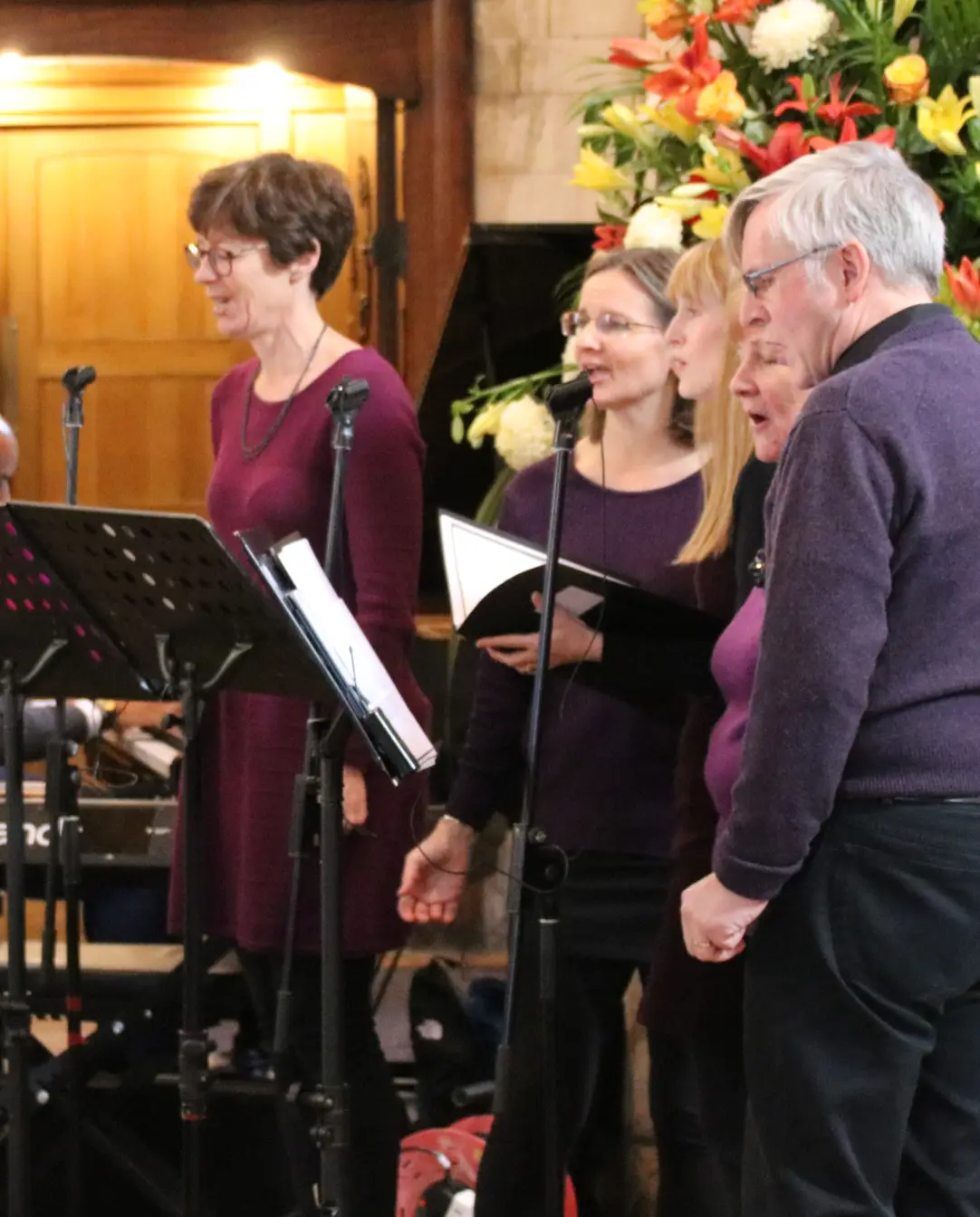
Dr Edson, with his remarkable knowledge of Bristol’s history and its story up to the present day, gave us much to think about. The visit to St Mary Redcliffe Church, the hospitality and welcome offered by Fr Brutus, and his reflections on the church’s links to wealth generated through the transatlantic slave trade highlighted the complexity of our heritage and the importance of engaging honestly with the past. The choir were wonderful and added greatly to the sense of welcome, helping to make the visit a memorable and uplifting experience.
Dr Edson’s reflections at the empty plinth of Colston prompted important questions about how we remember history and respond to ongoing injustice. I 
Overall, it was encouraging to see how churches can create spaces for learning, reflection, and transformation while remaining rooted in faith and hope.
More broadly, the pilgrimage reminded me that racial justice work is not only about understanding history but also about discerning how we are called to act in the present. Hearing the stories of local activists, abolitionists, and community champions reinforced the importance of truth-telling, remembrance, and collective action. It reminded me that our commitment to racial justice must be informed by honest engagement with the past while inspiring, faithful action in the present and hope for the future.
The Revd Beverley Ejimofo, Pilgrimage Coordinator
Seeing Bishop Rosemarie bringing four large bags of food and drinks and walking up and down the coach serving the guests. I knew at that moment it was going to be a precious time.

The laughter and camaraderie made such an impact on me at every stage of the journey. People looked out for each other, helped one another. Even when we were delayed after the puncture for several hours, my enduring memory is that we used it as an opportunity to grow as sisters and brothers in Christ. Again, laughter was the underpinning foundation, and with so many having to get up early to preside at services, I didn’t hear a single complaint.
I was so blessed to hear spontaneous thanks and people saying how much they were enjoying the pilgrimage.
Again, I was humbled to see people writing intently in their handouts, taking copious notes and photographs, and truly engaging with the pilgrimage.
The Revd Cordella Dawson, Vicar, St Philip’s Church, Norbury

The Revd Canon Patrick Eggleston, Priest-in-Charge, Thamesmead Team Ministry
A truly memorable day for all the right reasons – thank you so much to Beverley, Bishop Rosemarie and Reg for organising and leading it. It was a privilege to part of it.
Dr Edson was such a fount of knowledge, and it was fascinating to hear what he had to say about all the locations that we visited. And the welcome and hospitality that we received at St Agnes was out of this world.
As with all pilgrimages, it was not just the places we visited that stand out, but the conversations with fellow pilgrims along the way. And I had so many as we made our way from St Agnes to the Cathedral. And yet more at the M4 service station on the way back!
It was a really interesting mix of people that we had, and good to have pilgrims from across the Diocese. Plus, the two Church Commissioners representatives.
Matilda Taylor-Young, Churchwarden at St John’s Walworth
Yeanoh and I went on this pilgrimage. Yeanoh had lived in Bristol for some years before migrating to London.


We had brunch with a cross section of the church family here and then left for The Seven Saints of St Pauls; Audley Evans, Clifford Drummond, Owen Adolphus Henry, Roy Hackett, Carmen Beckford, Delores Campbell and Barbara Dettering. These are seven community figures who shaped the life of the St Paul’s neighbourhood. They are activists, artists, educators and elders whose names and stories are woven into Bristol’s black history.
It was interesting to note that John Wesley was a committed opponent to the slave trade at a time when it enriched much of the city and churches around him. It is said that he called it “the sum of all villainies”. John Wesley’s New Room was 3rd on our list but due to time constrains so it was skipped.

However, the church is currently working hard to honestly face that history and work to racial justice. This is a very beautiful church but carries a painful history. It is said to be an example of English Gothic architecture, consequently its not surprising that it’s a grade one listed building. The church is so large I mistook it for Bristol Cathedral only to find out that I am not the first and won’t be the last.

After the toppling of Colston’s statute in 2020 the church removed four stained glass panels dedicated to Colston and temporarily replaced them with plain panels. After consultation with various community groups and a design competition, these have now been replaced with a series of images by Ealish Swift, who won the competition showing non-white Jesus in a variety of situations.
Sophia Jones, Freelance Communications Consultant

Visiting the St Paul’s area of the city had been on my wish-list because of its Caribbean history. I was now able to tick it off the list as this was the first stop. This is where, we were told by our guide Dr Edson, immigrants from the Caribbean settled in the 1950’s and 1960’s. We were greeted with a warm welcome at St Agnes Church and members of the congregation served us with a hearty Caribbean brunch. St Agnes, we were told, has always been a place of warmth and welcome. In fact, it was the first church that welcomed the Windrush generation. It is also well known through the generations within the community of St Paul’s. It was integral in the formation of the St Paul’s Carnival and the Bristol bus boycott.
Our bellies full, we continued our pilgrimage into the wider community of St Paul’s. The booklets we were given for the pilgrimage guided us in our reflections. Another highlight for me was the Seven Saints of St Paul’s, huge murals on the sides of houses throughout St Paul’s honouring seven community figures who shaped the life of this neighbourhood, Bristol and the nation. People like civil rights activists Delores Campbell and Audley Evans who instigated the Bristol Bus Boycott. A group of young men on the street corner played Reggae dancehall music and as we passed by. Me and a fellow pilgrim paused briefly to “dance” to the tune we knew quite well. They encouraged us to visit community centre where we could find delicious Caribbean food. Had we not just eaten, I told them, we would have. The community centre is another hub in the heart of St Paul’s supporting the local community.
As we signalled our thanks and continued on our way out of St Paul’s, I was reminded of pilgrims of old. I’m sure they would have been welcomed by the local people in much the same way – although I doubt they would have danced to the latest dancehall Reggae tune back then!
Visit our page on anti-racism for more information about racial justice and Southwark’s work in the space of anti-racism.