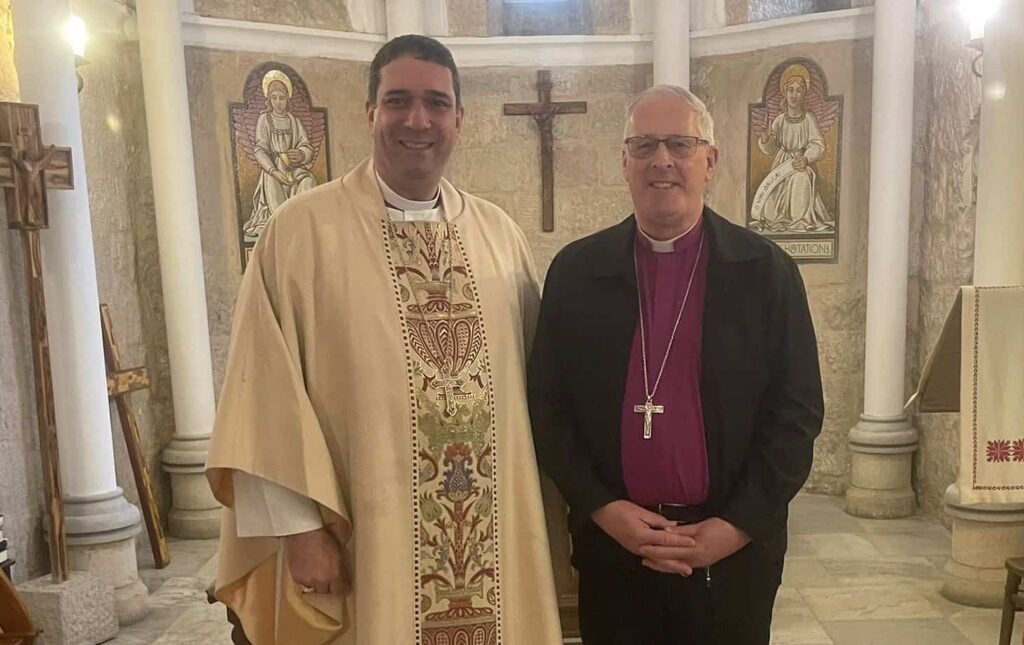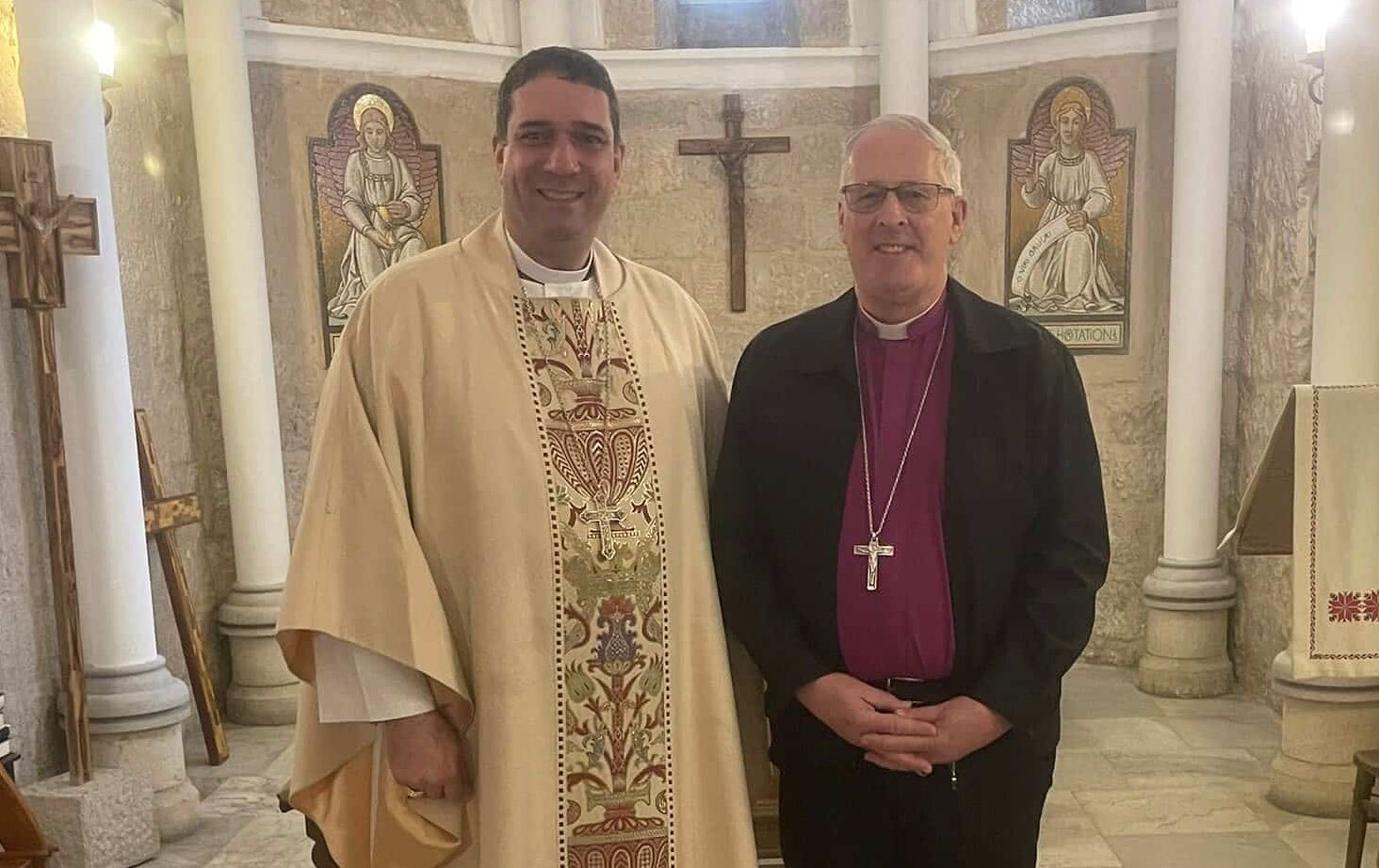


Members of Synod, brothers and sisters in Christ, I returned this week from a very blessed pilgrimage to Rome and Assisi with pilgrims from our own Diocese and the Roman Catholic Archdiocese of Southwark. The pilgrims were led by Bishop Paul Hendricks who is an Auxiliary Bishop in the Archdiocese, Canon Michael Branch the Dean of St George’s Cathedral, our own Dean of Southwark, and myself. I am also glad that Bishop Rosemarie as well as Bishop Richard and Felicity Cheetham were among our happy band. We alternated the Eucharists by rite – Roman Catholic and Anglican – and when the Eucharist was celebrated according to the Roman rite, the Anglicans made their communion from a reserved sacrament consecrated according to our rites, and vice versa. In this way we expressed the unity of our common faith, experienced spiritual ecumenism at a deep sacramental level and together proclaimed that Christ has died, Christ is Risen, and Christ will come again.
On the third of March we visited the late Pope Francis’s tomb in the basilica of St Mary Major. It is the simplest of all the papal tombs – just a plain stone laid flat, with ‘Franciscus’ inscribed on it. Above the tomb is a cross depicting Christ the Good Shepherd. It was very moving to pray there and see this simple witness to a Christian life lived not for the love of power -which has no place whatsoever in the Kingdom of God – rather proclaiming the power of God’s love. In Assisi there was also utter simplicity as pilgrims venerated the mortal remains of St Francis – Il Povarello – with special provision for this as we approach the 800th anniversary of his death.
One of the most beautiful images in Christian art is Christ the Good Shepherd, carrying on his shoulders a lost sheep back to the safety of the flock and the shepherd’s care. It is an image that Christ applied to himself, drawing on Psalm 23 and other parts of the Old Testament where God is described as a shepherd of Israel. This is what Jesus is calling to mind when he says in St John’s Gospel, ‘I am the Good Shepherd’. One of the early Church Fathers used this picture of the Good Shepherd to work out what it means when the Church says that God joined our human life to his divine life in the person of Jesus – in other words what it means to say that Jesus is both fully God and fully human. The Good Shepherd, this Church Father observes, finds and brings the sheep back whole; he doesn’t rescue just a part of it, an ear or a leg snatched from the mouth of the wolf when, really, it’s already too late. No, the Good Shepherd brings the sheep safely home, entire and intact – he carries the whole sheep on his shoulders. By analogy, then, when God comes to save us in Christ we are saved entirely -not just our souls, or our minds, but our bodies, too. Not just those things about us that are strong and noble, but those things that are weak and less noble, too. This is possible because in Christ, God assumed the whole of our humanity. He took all of our life – every time and season – into God’s life. Indeed by his own suffering and death, Christ brings that, too, into God’s life, so that our suffering, our death is faced squarely by God.
We each testify to the love of the Good Shepherd. When we offer service or ministry in Christ’s name – whether in virtue of our Baptism, or because we have received the gift of Holy Orders – we should remind ourselves that we do so only because we have been borne on the shoulders of the Good Shepherd. We pass on only what we have received. We do nothing in our own power and “since it is by God’s mercy that we are engaged in this ministry, we do not lose heart” (2 Corinthians 4.1). Whatever treasure we have been given, we carry in “clay jars, so that it may be made clear” that the extraordinary power for salvation “belongs to God and does not come from us” (2 Corinthians 4.7).
We are still very much in the middle of our Lenten pilgrimage and I give thanks for the way our parishes and people are journeying through this holy season. The Passion and the Cross are before us. If we are to reach the joy of Easter, we must stretch out towards them in confidence and faith. Our pilgrimage of faith brings much joy. But it brings joy because it reveals reality to us: the reality of world “charged with the grandeur of God” that “flame[s] out, like shining from shook foil”, yes, but also the reality of our sin and shortcoming. For we can destroy as well as we can build and God’s beautiful precious world we have in the words of Gerard Manley Hopkins, “bleared, smeared with toil”. Look around you, our world as the poet continues, “wears man’s smudge and shares man’s smell” because men have chosen the love of power over the power of love.
Yet for all this, our pilgrimage bring us to the reality of God’s life shown to us perfectly and mercifully in Christ Jesus, who carries us on his shoulders to bring us safely home. Jesus reveals to us the “dearest freshness” still present in creation, and he sends his Holy Spirit who “broods with warm breast” and “bright wings” over the worn and weary world.
My friends, we are not those “who have no hope” (1 Thessalonians 4.13). We have the hope of Christ. We proclaim this hope – and this hope only – and we serve in the strength and with the purpose that only it can bring.
Almighty God,
whose most dear Son went not up to joy but first he suffered pain,
and entered not into glory before he was crucified:
mercifully grant that we, walking in the way of the cross,
may find it none other than the way of life and peace;
through Jesus Christ your Son our Lord,
who is alive and reigns with you,
in the unity of the Holy Spirit,
one God, now and for ever. Amen.
God’s Grandeur
Gerard Manley Hopkins (1844-1889)
The world is charged with the grandeur of God.
It will flame out, like shining from shook foil;
It gathers to a greatness, like the ooze of oil
Crushed. Why do men then now not reck his rod?
Generations have trod, have trod, have trod;
And all is seared with trade; bleared, smeared with toil;
And wears man’s smudge and shares man’s smell: the soil
Is bare now, nor can foot feel, being shod.
And for all this, nature is never spent;
There lives the dearest freshness deep down things;
And though the last lights off the black West went
Oh, morning, at the brown brink eastward, springs —
Because the Holy Ghost over the bent
World broods with warm breast and with ah! bright wings.