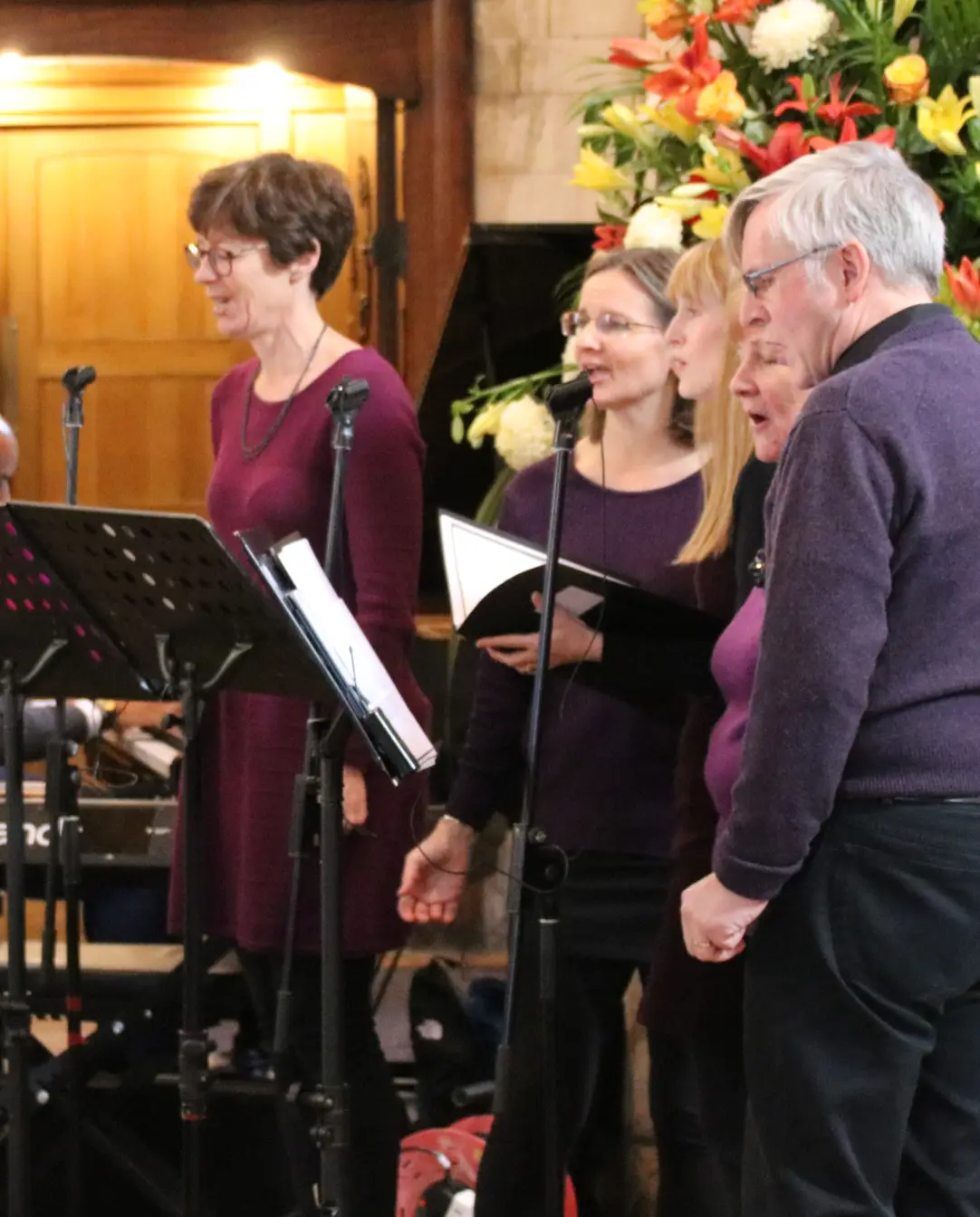


On Saturday 18 July 2026, Bishop Christopher presided and preached during a special valedictory eucharist at Southwark Cathedral ahead of his retirement this summer.
The full text of his sermon is below:
Romans 12. 9-end; Luke 24. 13-35
My Lord-Lieutenant, worshipful Mayors, ecumenical, interfaith and civic colleagues, family and friends who have travelled to be here – some from as far as Zimbabwe – we ae honoured by the presence of Bishop Osiward from our link Diocese of Masvingo and it is good to see Bishop Julius Makoni – I had not known you would be joining us and that is a joyful surprise. We are also honoured by the presence of the Archbishop of Southwark – to some degree my opposite number – only as an Archbishop he is rather more exalted. I need to say that I would not be here today were it not for the expert medical care I have received at King’s College Hospital – Professor Fan and Professor Edmonds are with us – the heads of two of the departments there – and I thank you for your care and that of your colleagues. Good to see the happy bands of pilgrims from the many pilgrimages which have marked these 15 years and which I have so loved, and so many dear brothers and sisters from our parishes – thank you for coming. When I came into the Diocese 21 years ago, Bishop Richard Chartres accompanied me to half way across London Bridge – he wanted to be sure I crossed the river into the Diocese of Southwark and I am thankful that he and Caroline are with us also.
As a person approaches retirement, there are inevitably plenty of opportunities to say goodbye – but there are rarely enough opportunities to express appreciation and gratitude. So, the first and most important thing I wish to say today is “thank you”. Thank you for who you are, and for all that you give. I retire with a deep and heartfelt sense of gratitude for the joy of walking alongside you as fellow pilgrims in the way of Christ, and all of us working together for the common good. It has been a great and joyful privilege to serve in this wonderful Diocese, caring from 2005 for the Woolwich Episcopal Area and then since 2011 for South London and East Surrey as Diocesan Bishop. Thank you.
I have found the image of being shepherd and chief pastor a compelling one. In our church primary schools holding a real shepherd’s crook I ask ‘What am I ?’ One of the children will invariably shout out ‘a shepherd’ and when I say for instance, ‘well, there are’nt any sheep in Peckham’ – something I realise will be to the bewilderment of my farming friends who have travelled from Cornwall to be with us today – with great glee the children say ‘we are your sheep’. Christ the Good Shepherd is a compelling image but a former Bishop of Southwark said to me, choosing a different animal, ‘Christopher, you will need the wisdom of Solomon and the hide of a rhinoceros!’.
“Let love be genuine; hate what is evil, hold fast to what is good; love one another with mutual affection; outdo one another in showing honour. Do not lag in zeal, be ardent in spirit, serve the Lord. Rejoice in hope, be patient in suffering, persevere in prayer” (Romans 12. 9-12)
I chose the readings for today because they summarise for me two key elements of the Church’s common life. That is, to be part of the Church – or to interact with the Church in any way – is to encounter a body of people who are called to live relationally and vocationally. In his Letter to the Church at Rome, St Paul instructs the faithful how they should order their relations. “Live in harmony with one another,” he writes. “Do not be haughty, but associate with the lowly; do not claim to be wiser than you are. Do not repay anyone evil for evil, but take thought for what is noble in the sight of all. If it is possible, so far as it depends on you, live peaceably with all” (Romans 12. 16-18). Paul does not promise the faithful an easy life – the instruction not to repay evil for evil, and the realism of “as far as it depends on you”, make this clear. But the great saint is clear how Christians should live.
We have so many blessings in Southwark for which to be thankful. Christians in the United Kingdom do not experience the persecution that Christians do in other parts of the world – in northern Nigeria, for instance, or in Syria – nor we experience the prejudice or intolerance that other revered faith communities encounter in this land, sometimes (to our national shame) violently. Last year a Vatican commission documented over 1,600 martyrs killed in the first twenty-five years of this century. Pope Leo spoke of their martyrdom as “a hope filled with immortality”.
So when we in this Diocese or in the Church of England more widely have our differences of conviction on the contentious issues of the day, we need to hold these honourably and we also need to hold faith with the suffering church. That is, we need to hold our convictions in good faith but also in perspective, by speaking well of each other and by honouring one another, especially when convictions differ. This has been something of a refrain of mine. Nevertheless, I commend it to you again as both a personal and a corporate discipline. Give thanks for your neighbour, give thanks for those who sit in the next pew, give thanks for those who worship in the next parish, give thanks for fellow members of the Body of Christ who are different to you. It is difficult to feel badly towards someone for whom you give thanks. For to give thanks recognises the good in another, and when we recognise the good in our neighbour, we are more likely to intend good – which, my brothers and sisters, is the definition of genuine love.
If St Paul outlined his expectation for the Church relationally, the Gospel story we heard sets it out vocationally. The two traumatised disciples, witnesses to the appalling violence of the Roman Empire, were so preoccupied in their grief that they fail to recognise that the apparent stranger walking with them on the road is none other than the risen Christ. The Gospel-writer says “their eyes were kept from recognising” Jesus (Luke 24.16). Grief does this – but they were not so preoccupied that they declined to speak to a stranger. Thank God – for it was at the moment that they offered hospitality and received Jesus that they were able to recognise the person before them. Yes, their hearts had been burning within them as they walked and talked along the road, but their eyes were opened when Jesus was “at the table with them” (Luke 24.30).
Jesus met these disciples in the condition of their need, and he meets us in the same way. He is infinitely kind. Is not this knowledge the source of our vocation? Is it not the fire that burns within, whose warmth causes us to share the riches of God’s story – through the Scriptures, through worship (especially in celebrating the Eucharist), and in service of our neighbour? Cleophas and his unnamed companion are an example to the Church by telling others “what happened on the road and how he had been made known to them in the breaking of the bread”? (Luke 24.35). The Church must not forget to do likewise. That is our vocation.
The disciples on the road to Emmaus found that their sorrowful journey became a pilgrimage of joy because they journeyed with the Risen Christ. As it was for them, so it is now: no matter what is before us, Christ goes with his Church. And I implore you to love the Church.
This stage of my personal pilgrimage is coming to an end. None of us knows what is ahead, but I am confident in my companion on the road and at the table. This part of my race is run, and I hand the baton on with great confidence, with heartfelt thanksgiving, and “rejoicing in hope” to use St Paul’s phrase. Dear friends, this is exactly as it should be – it is the story of the Church down the ages. Bishop Rosemarie as Acting Bishop of Southwark, my episcopal colleagues Bishop Alastair and Bishop Martin, Nicola the Diocesan Secretary, and all the members of the senior staff are a great team. The Diocese is in good hands, and “the one who calls you is faithful” (1 Thessalonians 5.24).
Pray for me, as I shall pray for you.
I ask now that I might go upon my way with your blessing and, if I may borrow some words from Sir Walter Raleigh, that I take “my scallop shell of quiet, / My staff of faith to walk upon, / My scrip of joy, immortal diet, / My bottle of salvation, / My gown of glory, hope’s true gage, / And thus I’ll take my pilgrimage”. Amen.